


2 Post Lift vs 4 Post Lift
An Honest, Expert Buyer’s Guide (2026)
Short answer: 2-post lifts are generally better for full vehicle service and undercar access, while 4-post lifts excel at storage and drive-on convenience.
Long answer: Choosing between a 2-post and 4-post lift depends on how you plan to use it — daily mechanical work, long-term vehicle storage, alignment service, or general garage expansion. This guide explains how each lift works, where each type excels, limitations to consider, and who each is best suited for, so you can make the right investment.
Why You Can Trust This Guide
At ToolPan, we help shops and home garage owners choose lifts based on real-world installation outcomes, long-term durability, and safety considerations, not just spec sheets.
This guide is based on:
-
Installation feedback from residential and commercial garages
-
Structural and safety analysis
-
Usage patterns across service, storage, and specialty work
-
Warranty and certification considerations
 Who Should Choose a Two-Post Lift (And Who Shouldn’t)
2-Post Lifts Are a Strong Choice If:
-
You perform brake, suspension, exhaust, or drivetrain work
-
You need full undercarriage access
-
You run a mechanical repair shop
-
You want maximum access to wheels and frame
-
You have sufficient ceiling height and proper concrete thickness
2-Post Lifts May NOT Be Ideal If:
-
You mainly want vehicle storage
-
You prefer simple drive-on convenience
-
Your concrete slab is thin or not reinforced
-
You’re uncomfortable with asymmetric arm positioning
Popular 2-Post Lift Brands
-
Atlas 2-post lifts – well-rated for service bays
-
Amgo 2-post lifts – value-oriented choice
-
Daytona 2-post lifts – mid-tier performance
Katool 2-Post Lifts - most budget-friendly option
-
Triumph 2-post lifts – budget-friendly options
2-post lifts are typically preferred where mechanical access and versatility are priorities.
 Who Should Choose a Four-Post Lift (And Who Shouldn’t)
4-Post Lifts Are a Strong Choice If:
-
You want vehicle storage
-
You prefer drive-on simplicity
-
You need a lift for alignment or tire service
-
You want easier setup with less floor anchoring
-
You plan to store vehicles long term
4-Post Lifts May NOT Be Ideal If:
-
You need full access to wheels and suspension daily
-
You want minimal floor footprint
-
You prioritize mechanical service over storage
Popular 4-Post Lift Brands
-
Atlas 4-post lifts – shop-tested reliability
-
Amgo 4-post lifts – great value for home garages
-
Daytona 4-post lifts – stable platform with good pricing
Katool 4-Post Lift - most affordable option
-
Triumph 4-post lifts – very popular storage solutions
4-post lifts are often preferred for storage, drive-on convenience, and alignment workflows.
How 2-Post and 4-Post Lifts Work
2-Post Lifts
-
Vehicle is lifted by swing arms contacting frame lift points
-
Wheels hang freely
-
Excellent access to suspension and undercar components
-
Requires proper anchoring to reinforced concrete
4-Post Lifts
-
Vehicle drives onto runways/platforms
-
Lift raises entire vehicle by tires
-
More stable feel for storage
-
Often easier for first-time lift owners
Both designs are safe when properly installed and used within rated capacity.
Popular Use Cases
Common 2-Post Applications
-
Brake jobs
-
Suspension repairs
-
Engine and transmission work
-
General mechanical service
Common 4-Post Applications
-
Long-term vehicle storage
-
Parking multiple vehicles in one bay
-
Alignment service (with turn plates and jacks)
-
Detailing and inspections
Each type excels in its intended purpose.
2-Post vs 4-Post Lift Comparison Table
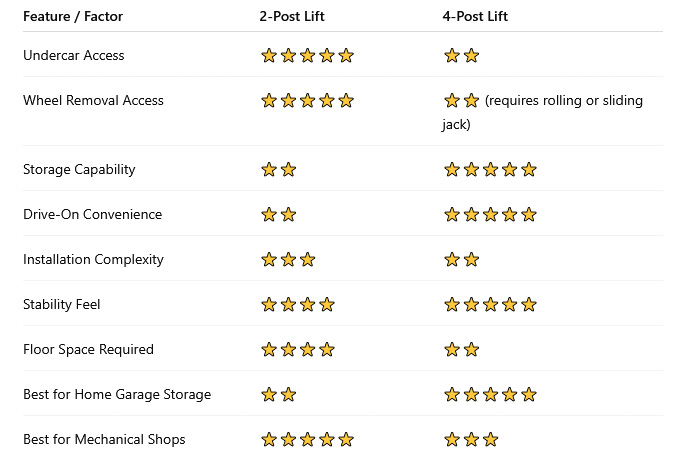
The choice depends on whether you prioritize service access or storage convenience.
Safety, Certification & Installation Considerations
Regardless of lift type, you should evaluate:
-
Concrete slab thickness (usually 4–6 inches minimum for 2-post)
-
Ceiling height
-
Electrical requirements
-
Vehicle weight capacity
-
ALI certification (if required for insurance or compliance)
Proper installation and anchoring are critical for safety — especially for 2-post lifts.
Warranty & Long-Term Ownership Considerations
Both lift types typically offer:
-
Structural warranties (often 5 years)
-
2-year hydraulic/electrical coverage
-
1-year limited parts coverage
Long-term durability depends on:
-
Duty cycle
-
Maintenance
-
Proper installation
-
Cable adjustments and hydraulic servicing
2-post lifts may require more frequent cable adjustments, while 4-post lifts often have simpler maintenance schedules.
Final Verdict: 2-Post vs 4-Post — Which Is Better?
There is no universal “better” lift — only the better lift for your needs.
Choose a 2-Post Lift if:
-
You perform mechanical repairs regularly
-
You need full undercar access
-
You want maximum versatility for service work
Choose a 4-Post Lift if:
-
You want vehicle storage
-
You prefer drive-on convenience
-
You want easier installation and stability
For many serious enthusiasts, the ideal solution is eventually owning both.
Need Help Choosing the Right Lift?
If you’re unsure whether a 2-post or 4-post lift fits your garage layout, ceiling height, or workload, our team can help you match the right lift to your space before you buy.
Featured BrandsSee All Brands


